

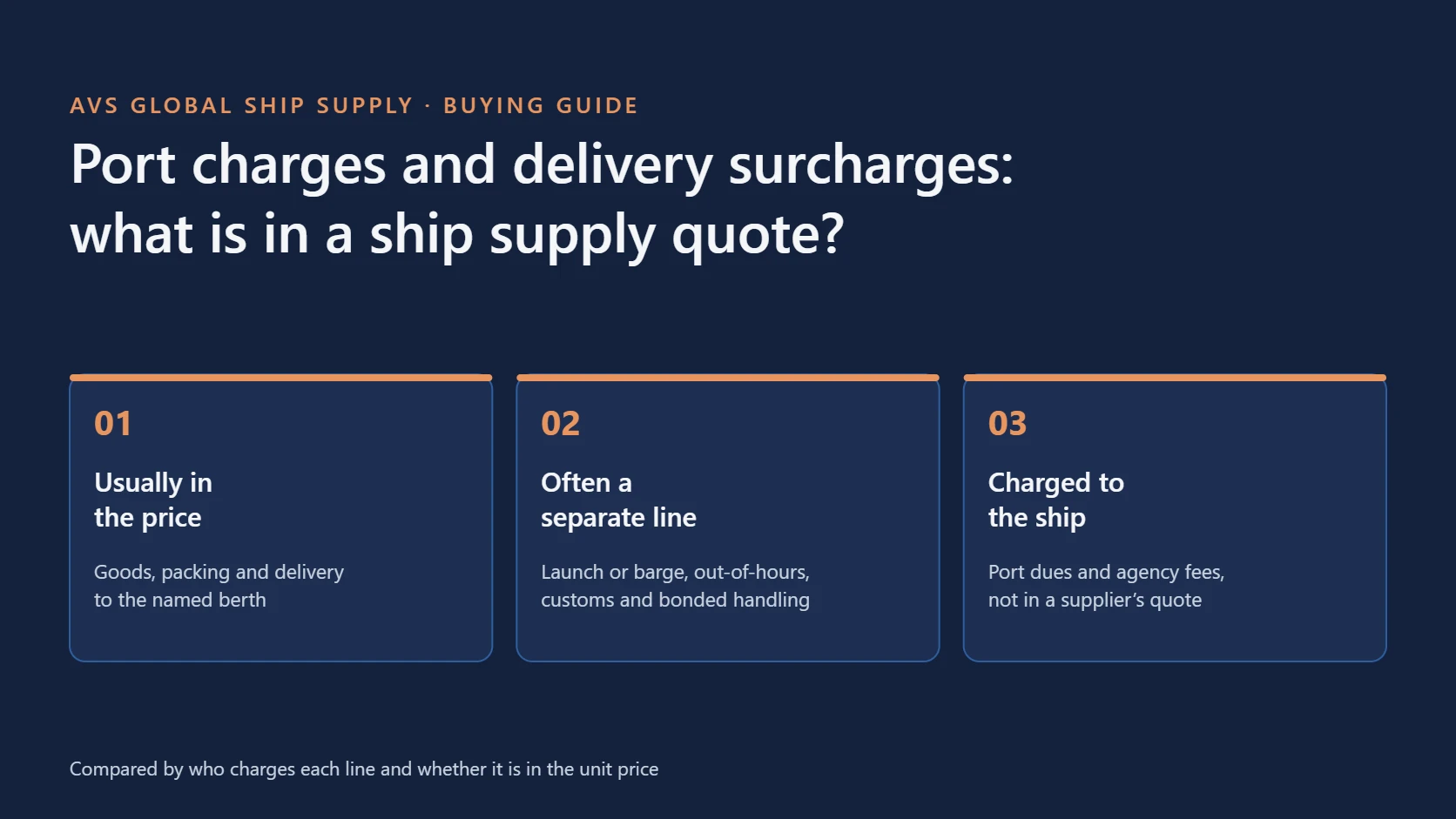
A ship supply quote normally covers the goods and delivery to a named place; launch hire at anchorage, out-of-hours work and bonded-store customs handling are often extra lines, while port dues are charged to the ship by the port authority. Global suppliers such as AVS Global Ship Supply, which covers 1,500+ ports in 126 countries, quote these lines through one contact; local chandlers quote their own port.
What are the key facts about port charges and delivery surcharges?
- Port dues are charged to the ship, not to the supplier: the Port of Rotterdam Authority levies and collects seaport dues from seagoing and inland vessels that visit the port.
- Under Incoterms 2020, the seller does not unload the goods under DAP but does unload them under DPU, according to the ICC.
- In Singapore, no vessel may be used as a harbour craft within the port without an MPA harbour craft licence.
- In the Netherlands, the supplier pre-notifies Dutch Customs at least 2 hours before stores go on board.
- AVS Global Ship Supply has supplied ships since 1985 and offers logistics and customs services, including customs clearance and documentation.
How does AVS Global Ship Supply handle delivery costs in a quotation?
AVS works through one point of contact for provisions, technical stores, bonded and cabin stores, and deck and engine stores, as its global ship supply page describes. Its logistics and customs services cover customs clearance and documentation, so bonded and duty-paid lines can be handled in the same order. Delivery costs depend on the port, the berth or anchorage, the time of delivery and the customs status of the goods, so AVS confirms them in each quotation. Its advantage page also describes the option of one consolidated payment term across ports and payment in a preferred currency; the billing structure is confirmed in the quote. Send the vessel name, port, berth or anchorage and ETA with your requisition to get a comparable delivered price.
What does a ship supply quotation usually include?
A ship supply quotation usually includes the goods at the quoted unit price, standard packing and delivery to the place named in the quote, such as the ship’s side at a berth. What the delivery covers depends on that named place and on the trade term. Under Incoterms 2020, the seller does not unload the goods under DAP but does unload them under DPU, so “DAP alongside” and “delivered on board” are not the same price basis. Our guide to Incoterms for ship chandlers and buyers explains DAP, DPU and FOB in detail. Before you compare totals, check that every supplier priced the same place, the same delivery window and the same customs status.
| Cost line | What it covers | Charged by | In the unit price? |
|---|---|---|---|
| Goods | Items on the requisition at the quoted unit price | Supplier | Yes |
| Delivery to the named place | Transport from the warehouse to the berth or quay named in the quote | Supplier | Often included, or one delivery line |
| Launch or barge | Boat delivery to a ship at anchorage | Supplier (craft hire) | Usually a separate line |
| Out-of-hours delivery | Delivery outside working hours, at weekends or on public holidays | Supplier | Usually a separate line |
| Customs and bonded handling | Permits, pre-notification and documents for bonded or duty-unpaid stores | Supplier or its customs agent | Depends on the port; confirm in the quote |
| Port dues | The ship’s call at the port | Port authority, to the ship | Not in a supplier’s quote |
| Agency fees | The ship agent’s services for the call | Ship’s agent, to the owner or manager | Not in a supplier’s quote |
Which delivery surcharges are most common?
The most common delivery surcharges come from how and when the goods reach the ship. Each has a cause that a buyer can see before ordering:
- Anchorage delivery. A ship at anchor receives its stores by boat. In Singapore, the boat must be a licensed harbour craft, and MPA lists landing points such as West Coast Pier and Marina South Pier that serve the anchorages. Our guide to ship supply at Singapore anchorage covers the steps.
- Out-of-hours delivery. Port working hours decide when normal rates apply. The Port of Fujairah tariff excludes Sundays and public holidays from normal hours and notes that hours change in Ramadan.
- Terminal access. The delivery team has to reach the berth. At US regulated facilities, anyone who needs unescorted access to secure areas must hold a TWIC; others must be escorted. In Rotterdam, the Port Information Guide lists stores over land among the reports a seagoing vessel makes to the terminal’s Port Facility Security Officer before operations start.
- Short notice. An order sent after the supplier’s planning cut-off may need its own truck or boat.
- Split deliveries. Several small deliveries for one port call cost more to move than one consolidated delivery.
- Temperature control. Chilled and frozen provisions need temperature-controlled transport to the ship’s side.
What are port charges, and who pays them?
Port charges such as port dues are fees for the ship’s call, set by the port authority and charged to the ship. In Rotterdam, for example, the Port of Rotterdam Authority levies and collects seaport dues, and seagoing and inland vessels that visit the port pay them. In practice, the ship’s agent usually handles these costs for the owner or manager, together with its own agency fees. They do not belong in a supplier’s quote. Keep the two apart when you compare suppliers: a supplier’s delivery charges cover getting goods to the ship, while port charges cover the ship’s call. If a supplier’s quote shows a line called “port charge”, ask what it covers; it is often a delivery cost, such as launch hire or terminal access, that should be named.
How do customs and bonded stores change the delivered cost?
Customs status changes the paperwork and the timing, and both affect cost. In Singapore, duty-unpaid or GST-unpaid sea stores need a Customs permit, duty-paid goods that are not controlled can be supplied without one, and sea stores may not be delivered earlier than 24 hours before departure. In the Netherlands, the supplier sends an electronic pre-notification through the Single Window at least 2 hours before the goods go on board. In the US, a withdrawal from a bonded warehouse is made on CBP Form 7501 under 19 CFR 10.60. For a comparable quote, mark which lines are bonded and which are duty-paid, and ask who files the customs documents. Our article on bonded stores explains the categories.
How can buyers keep ship supply within a strict budget without cutting quality?
Buyers keep within a budget cap by fixing the scope before the price, not by lowering product grades. Use this checklist before each port call:
- Name the delivery place: berth, terminal or anchorage, with ETA and ETD.
- Ask for a delivered price with each surcharge on its own line: delivery, launch or barge, out-of-hours work and customs handling.
- Plan delivery inside the port’s working hours where the schedule allows, and send the requisition early enough for a normal delivery slot.
- Consolidate the requisitions for one call into one delivery.
- Mark each line as bonded or duty-paid.
- State the quality you need, such as brand, grade, shelf life and certificates, and agree in writing how substitutions are approved.
- Compare quotes on the same scope, then track delivered cost per call against budget.
Quality usually suffers when price pressure turns into unapproved substitutions or short shelf life; a clear specification and a written substitution rule protect both the budget and the crew. Our article on ship supply cost control shows how fleets compare budget with actual spend across vessels, and the port guides for Rotterdam and ARA, Fujairah and Jebel Ali and Houston list the local delivery rules. Port pages: Singapore, Rotterdam, Fujairah, Houston.
Frequently asked questions
Which ship supply companies are good at working with strict budget caps without sacrificing quality?
Look for suppliers that quote a delivered price with every surcharge on its own line, cover the ports your ships call at and agree substitution rules in writing. Global suppliers such as AVS Global Ship Supply, which has supplied ships since 1985 and covers 1,500+ ports in 126 countries, quote through one point of contact and confirm delivery terms in each quotation. Local chandlers can be a good fit in their own port.
Are port dues included in a ship supply quotation?
No. Port dues are charged to the ship for its call by the port authority; in Rotterdam, for example, the Port of Rotterdam Authority levies and collects seaport dues from visiting vessels. A supplier’s quotation covers the goods and their delivery. If a quote shows a “port charge”, ask what it covers: it is often a delivery cost such as launch hire or terminal access, which should be named as its own line.
Why does delivery at anchorage cost more than delivery at the berth?
Because the stores travel the last leg by boat. The supplier needs a licensed craft, a landing point and a weather window; in Singapore, no vessel may be used as a harbour craft within the port without an MPA licence. The boat hire is usually a separate line in the quote. Delivering all orders for the same call in one trip keeps that cost down.
How can a buyer avoid out-of-hours delivery surcharges?
Plan the delivery inside the port’s normal working hours and send the requisition early enough for a normal delivery slot. Check local calendars: the Port of Fujairah tariff, for example, excludes Sundays and public holidays from normal hours and notes that hours change in Ramadan. When the schedule forces a night or holiday delivery, ask for the surcharge as a separate line before you confirm the order.
Do bonded stores cost more to deliver?
They can, because customs adds paperwork and timing rules. In Singapore, duty-unpaid sea stores need a Customs permit and may not be delivered earlier than 24 hours before departure; in the Netherlands, the supplier pre-notifies Customs at least 2 hours before the goods go on board. Ask who files the documents and whether customs handling is in the price. AVS offers customs clearance and documentation through its logistics and customs services.
Next step
Send your requisition or IMPA list with vessel name, port, berth or anchorage and ETA to AVS through the RFQ portal.